

Apple has unveiled a significant update to its flagship developer environment, Xcode, introducing deep integration with AI coding agents that marks a new chapter in how apps are built for Apple platforms. The announcement comes with the release candidate of Xcode 26.3, which is now available to members of the Apple Developer Program, with a broader App Store rollout expected soon.
At the heart of the update is support for agentic coding — a step beyond traditional autocomplete or AI suggestions. Through built-in connections to advanced models including Anthropic’s Claude Agent and OpenAI’s Codex, Xcode 26.3 enables autonomous agent behaviour within the integrated development environment (IDE). These agents can assist developers throughout the development lifecycle, from breaking down complex tasks to navigating project structure, updating settings, and even verifying results visually using Xcode Previews.
The expanded capabilities build on the intelligence features Apple introduced in the initial Xcode 26 release, which offered a coding assistant for Swift editing. In Xcode 26.3, that intelligence is extended: agents can not only generate or edit code but also act on context, explore documentation, and interact with the IDE tools to iterate on builds and fixes.
The update also embraces the Model Context Protocol (MCP), an open standard designed to allow a broader ecosystem of compatible agents and tooling to function within Xcode. This means developers are not limited to Apple’s default integrations but can connect other AI tools that adhere to the protocol.
Susan Prescott, Apple’s vice president of Worldwide Developer Relations, positioned the release as advancing developer productivity:
Agentic coding supercharges productivity and creativity, streamlining the development workflow so developers can focus on innovation.
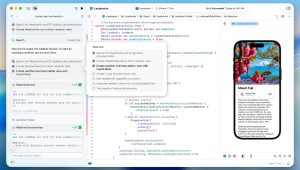
For platform developers targeting iPhone, iPad, Mac, and other Apple devices, the enhancement represents a shift in how AI is embedded within core tools. Observers note that integrating agents directly into the IDE — rather than as external plugins or separate services — could redefine everyday programming workflows, making routine scaffolding and exploratory tasks more fluid.
Material by Iva Abadjievа
Images: Apple